


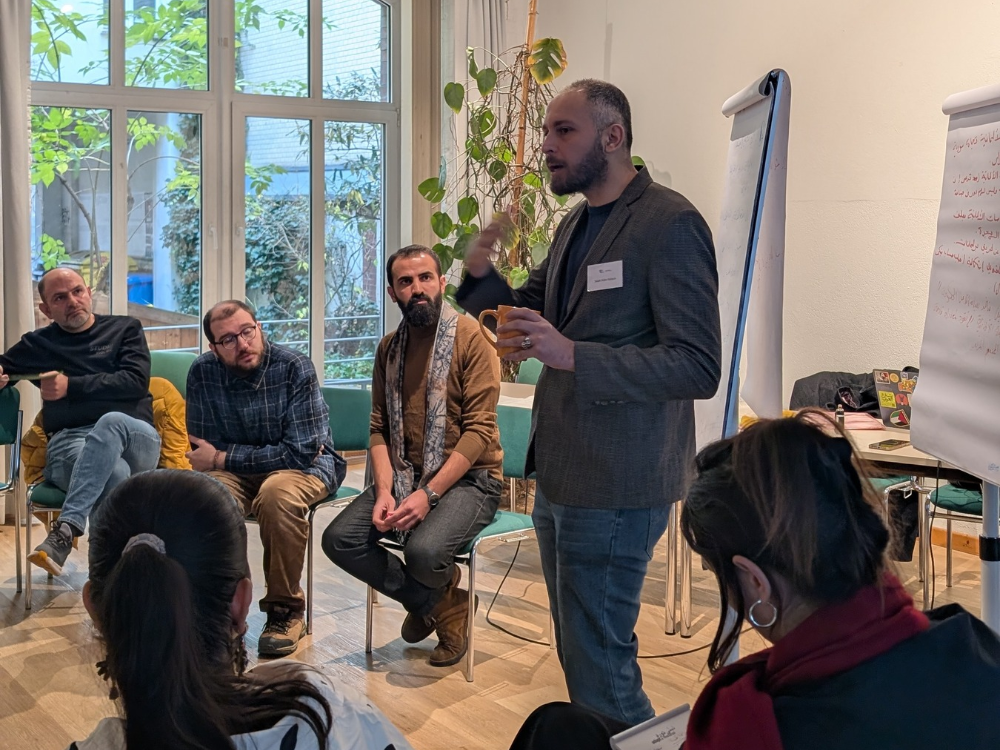
The discussions were structured around two main sessions: reflections on the conference and the challenges facing Syria’s transition. This was followed by a discussion on the role of civil society inside Syria and in the diaspora in shaping the country’s political future.
Reflections on the Conference and Syria’s Political Transition
The first session invited participants to reflect on the main discussions of the conference, the questions that remained unanswered, and the challenges facing Syria during this critical period. Participants were encouraged to consider what they would take back to their respective organisations and communities, which perspectives had been particularly important, and which issues had received insufficient attention.
Transitional justice emerged as one of the central topics of discussion, particularly following the appreciated participation of a representative of the Transitional Justice Authority in the conference. Participants raised questions about the prospects for a meaningful and comprehensive transitional justice process, the mandate and capacities of the responsible institutions, and the extent to which political will exists to address past violations and ensure accountability.
The discussion highlighted the importance of distinguishing between political will and institutional capacity. While concerns were raised about the political commitment to a comprehensive justice process, participants also acknowledged the considerable structural challenges facing Syria’s state institutions. The lack of reliable data, limited institutional resources, weakened administrative structures, and the absence of effective mechanisms for implementation represent significant obstacles. These challenges cannot be understood solely as a question of political priorities, but must also be considered in the context of the institutional destruction and fragmentation resulting from decades of authoritarian rule and years of war.
Beyond transitional justice, the discussions reflected the complexity of Syria’s current political situation. The country faces enormous challenges at multiple levels, from rebuilding state institutions and establishing the rule of law to addressing social divisions, economic devastation, and the continued exclusion of large segments of society from political decision-making.
These internal challenges are further complicated by regional instability and a changing international order, in which competing geopolitical interests continue to shape Syria’s political and economic prospects. The discussions underscored that Syria’s transition cannot be separated from its regional and international context, nor can meaningful stability be achieved without addressing the political and social conditions that have contributed to the country’s fragmentation.
Participants also reflected critically on the conference itself, identifying issues that deserved greater attention. Among these were the political participation of young people, the rights and inclusion of persons with disabilities, and the situation in Suwayda. These reflections highlighted the importance of ensuring that future discussions on Syria’s transition include perspectives and experiences that remain underrepresented in political debates.
The Role of Civil Society Inside Syria and in the Diaspora
The second session focused on the role of Syrian civil society in shaping the country’s political transition, with particular attention to cooperation between actors working inside Syria and those based in the diaspora. The discussion also raised questions about how the diaspora itself should be defined in the current context. Following the fall of the Assad regime, many civil society activists have returned to Syria to work on the ground, while others continue to operate both inside and outside the country. These developments have increasingly blurred the distinction between civil society actors in Syria and those in the diaspora, calling for a reassessment of these categories and the relationships between them.
The discussion explored how existing networks, experiences, and resources could be brought together to support a democratic transition grounded in human rights, equal citizenship, political participation, and social justice.
A central point of discussion was the importance of shared values as the foundation for meaningful cooperation. Participants emphasised that collaboration should not be based solely on common activities or organisational interests, but on a shared commitment to equality, human rights, democratic principles, and citizenship for all Syrians, regardless of their political, religious, ethnic, or social backgrounds.
At the same time, the discussion highlighted the importance of moving beyond cooperation at the organisational level towards broader engagement with society. Building popular support for democratic values, strengthening local initiatives, and creating spaces for political dialogue and participation were identified as essential elements of a sustainable democratic transition. Civil society cannot limit its role to advocacy and institutional engagement. It must also remain connected to the communities it seeks to represent and work with.
The relationship between civil society inside Syria and in the diaspora was discussed in this context. Participants explored how the diaspora could contribute through advocacy, international networking, knowledge exchange, and access to resources, while recognising the importance of locally grounded priorities and the experiences of those working directly within Syrian communities.
Another important dimension was the role of international advocacy, particularly in Germany. Discussions addressed how Syrian civil society actors could engage more effectively with German policymakers to promote policies that support meaningful and sustainable stability in Syria. Participants stressed the need to move beyond approaches that prioritise short-term security and superficial stability without addressing the underlying political, economic, and social conditions necessary for a democratic future.
Political empowerment and the legal framework governing political participation were also raised as important challenges. Although the fall of the Assad regime has opened new spaces for public debate, civic engagement, and political expression, the conditions for an inclusive and functioning political life remain very limited.
The absence or inadequacy of legal and institutional frameworks regulating political parties, civic organisations, and other forms of political participation continues to present obstacles. Participants highlighted the importance of establishing transparent and inclusive rules that enable citizens to organise, participate in political life, and hold institutions accountable.
The opening of public space does not automatically translate into the opening of political life. Without meaningful political rights, accountable institutions, and opportunities for citizens to influence decision-making, the current transition risks reproducing forms of exclusion rather than overcoming them.
Looking Ahead
The closed Session provided an opportunity to move beyond the analysis of Syria’s challenges towards a discussion of the responsibilities and possibilities for collective action.
While the discussions reflected different experiences and perspectives, they also highlighted the importance of continued dialogue and cooperation between Syrian civil society actors inside the country and in the diaspora.
The challenges facing Syria’s transition are immense, and no single organisation, initiative, or political actor can address them alone. Strengthening connections between local and diaspora actors, developing shared priorities, and building broader public support for democratic values remain important tasks for Syrian civil society.
Above all, the discussions reaffirmed that Syria’s future cannot be reduced to the question of stability or institutional reconstruction alone. A meaningful transition must also create the conditions for political participation, equal citizenship, accountability, and the ability of Syrians to shape their country’s future.


