


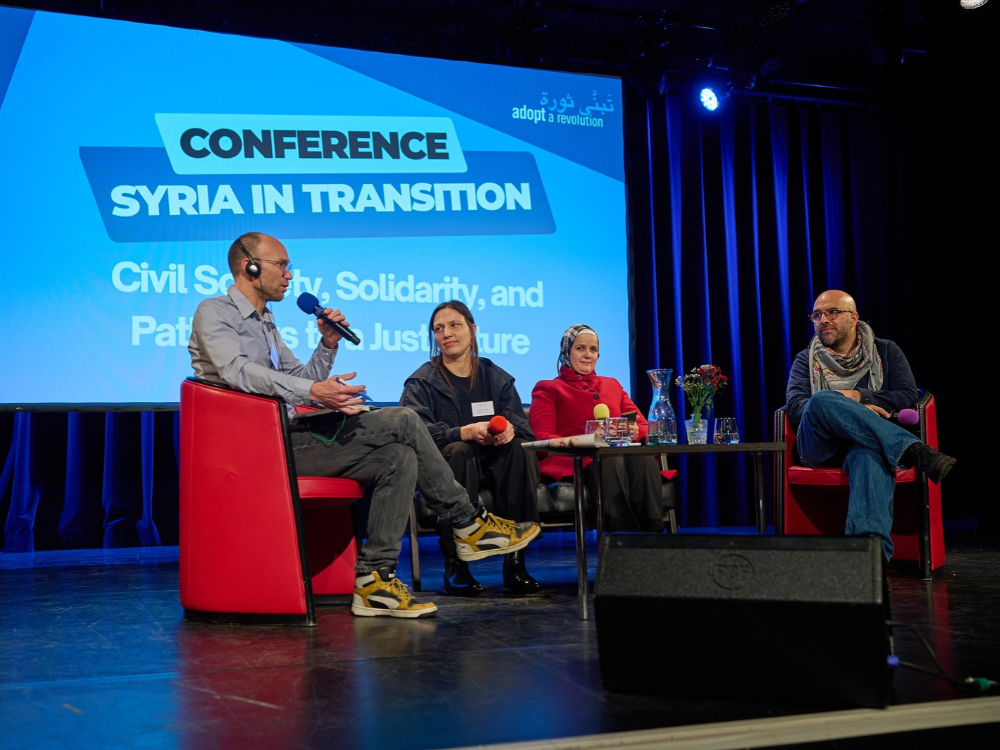
Two years after the fall of the Assad regime, around 120 participants took stock of the transition process in Syria so far. The expert conference “Syria in Transition: Civil Society, Solidarity, and Pathways to a Just Future,” organized by Adopt a Revolution, analyzed developments in transitional justice, women’s rights, social cohesion, economic policy, and political participation. It also addressed regional power interests, the role of German and international politics, and the future of solidarity with Syria.
“Who said it would be easy?” was the sober assessment from Syrian civil society. Over three days, participants discussed not only the obstacles to a democratic transition, but also how democratic forces can organize from below, build political pressure, and help shape decisions.
Most participants from Syrian civil society were rather critical in their assessment of the first two years of Ahmad Al-Sharaa’s transitional government. But rather than resigning, they made clear that the transformation is not complete, and that civil society has no intention of trading the former authoritarian structures for new ones. It continues to fight for democratic change.
Consolidation of Power Instead of Substantive Opening
The analysis of the current situation leaves little room for illusions: the increasingly authoritarian government is marked by a lack of transparency and geared toward consolidating power. Stability is the top priority, while democratic opening is postponed to a later date. At the same time, pressure is growing on independent civil society organizations, whose room for maneuver is being restricted.
The orientation of the transitional government is particularly evident in the lack of representation of women in politics and society. Although women played a major role in the revolution, they are now being systematically pushed out. “The future is being designed without us,” said Randa Hamo, a member of the Advisory Board of Adopt a Revolution. Joining remotely from Qamishli in the northeast of the country, she described how the achievements and scope for action that women had gained there are being rolled back. Huda Khaity, director of the women’s center in Idlib and a project partner of Adopt a Revolution, stressed that women’s political participation cannot be considered separately from economic and social living conditions. Without economic independence, women’s political self-determination remains limited. A credible transition, she said, must include all parts of society.
The discussion made clear that it is not enough to grant women a few individual seats on political bodies. What is needed are independent women’s organizations, sustainable alliances, and binding opportunities to help shape political decisions. At the same time, patriarchal power relations must also be questioned and changed within civil society itself.
Justice as a Prerequisite for a Fresh Start
The debate on transitional justice also showed how difficult a democratic new beginning is. After decades of state violence, torture, enforced disappearances, and displacement, survivors face the question of whether and how those responsible, will be held accountable.
The discussion made clear that coming to terms with the crimes of the Assad regime is not solely a legal task. It also involves the search for missing persons, the right of relatives to the truth, the acknowledgment of the injustice suffered, and, not least, the urgently needed reform of state institutions.
The question was raised of how independently the new institutions can actually operate, and what opportunities victims and civil society organizations have to help shape the process of accountability. Transitional justice must also meet the standard of prosecuting human rights violations regardless of who committed them, including those committed after the fall of the Assad regime.
A key insight: without credible accountability, independent institutions, and the participation of those affected, it will be hard to rebuild trust in the state.
Social Cohesion Emerges from Below
On the topic of social cohesion, too, participants showed how little inclusive the transition process is from their perspective. Social divisions in Syria have been deepened by years of deliberate instrumentalization. They are by no means merely sectarian in nature, but are rooted in an unequal distribution of power, rights, and resources. Mutasem al-Syoufi of the Syrian NGO “The Day After” criticized that, rather than uniting society, the building of the new institutions is deepening these divisions even further: state structures are being built from the top down and along sectarian lines, without genuine societal dialogue and without involving all population groups.
“We have no influence on decision-making in our own country; even the parliament was imposed on us,” was the diagnosis of Mostafa Al-Hamod from Aleppo, a member of the Advisory Board of Adopt a Revolution. At the same time, he reported positive experiences from local practice: where people work together on concrete problems, such as water supply or access to education, trust can grow again across regional and social boundaries. Such practical forms of cooperation can also lay the groundwork for tackling more difficult questions of justice, mutual recognition, and how to deal with past experiences of violence.
Trade unions, farmers, and other professional associations are currently reorganizing. His plea was that they should not formulate their demands in isolation, but as a coherent struggle for social justice.
A Regime of the Top One Percent?
A highly centralized, authoritarian presidential system is currently being built in Damascus. Academics confirmed this perception of Syrian civil society in the panel discussions.
While the new power elite seeks international recognition, democratic reforms in key areas, such as electoral and party legislation or the decentralization of administration, are largely at a standstill. Rather than democratization, one can observe the active prevention of democratic participation, analyzed Dr. André Bank of the German Institute for Global and Area Studies (GIGA).
Bank identified the transitional government’s neoliberal clientelism as the greatest risk of renewed instability. The discussion on economic reconstruction and reform likewise showed that the question of Syria’s economic future is always also a question of political power: Who decides on investments? Who controls resources? Who benefits from reconstruction?
Economist Dr. Joseph Daher described the emerging economic order, in pointed terms, as a policy that serves the “top one percent.” The criticism was directed at an economic policy that relies on private investment and the interests of a small elite, while social protection, public services, and societal participation recede into the background.
Economist Dr. Salam Said also emphasized that public services must be affordable for the population. People cannot afford treatment at a private hospital. The manufacturing sector and agriculture must be rebuilt. Fair labor laws are also needed.
A reconstruction that primarily benefits politically well-connected companies and new economic elites threatens to exacerbate existing inequalities even further. Without social justice, transparent decision-making, and economic prospects for broad parts of the population, lasting stability cannot be achieved either, several participants emphasized.
Syria’s Future Caught Between Regional Power Interests
The discussion on the role of regional and international actors showed how great the obstacles to a democratic transition are. Syria’s political future will not be decided in Damascus alone. The interests of external powers often conflict with the demands of Syrian civil society for democracy, justice, and political participation, concluded Dr. Muriel Asseburg of the German Institute for International and Security Affairs (SWP).
For major powers such as Russia and China, the democratization of Syria is not a goal; for the United States, it is not a priority. For Turkey, security interests take precedence, while the Gulf states, such as Qatar and the United Arab Emirates, want to exert political and economic influence over reconstruction. For Iran and Israel, an interest in a fragmented and weak Syria prevails.
What matters, therefore, is which political developments are strengthened through international recognition, investment, and economic cooperation. If external actors focus primarily on short-term stability and cooperation with the new rulers, this threatens to further favor authoritarian consolidation of power.
The experiences of other countries in the region show that the fall of an authoritarian regime does not in itself guarantee a democratic transition. Syrian civil society therefore faces a dual challenge: to fight for democratic participation in their own country while also persuading international actors not to subordinate these demands to geopolitical interests.
Stability at Whose Expense?
The debate on the role of the international community, and Germany in particular, in Syria was correspondingly tense. The demand of Syrian civil society toward the German federal government was clear: support and political recognition for Damascus must be strictly tied to democratic development and respect for women’s and human rights. Furthermore, funding for civil society organizations must not be made dependent on whether they cooperate with the transitional government. What matters is whether and how the perspectives and interests of Syrian civil society are taken into account in German policy, said Danaé Panissié of Adopt a Revolution.
Tobias Caris of the Federal Foreign Office explained the federal government’s course. The top priority, he said, is Syria’s stability. In response to calls from the audience for the federal government to publicly criticize the transitional government in Damascus, he replied that it would be more promising to raise such matters “behind closed doors.”
German development cooperation also faces fundamental decisions. Katja Setzkorn of the German Agency for International Cooperation (GIZ) in Damascus explained how cooperation with Syria has changed and the possibilities for working more closely with state institutions again and building their capacities. However, she said, GIZ continues to work closely with Syrian civil society organizations.
In the discussion on the role of German politics, several diaspora participants spoke critically and emotionally about the current debate on return in Germany. They made clear what consequences the federal government’s communication about return is already having: a paralyzing fear and great uncertainty about their own future in Germany. As long as the rule of law and security are lacking in Syria, there can be no talk of “voluntary return with dignity.”
International Solidarity Instead of Charity
In view of an international policy that relies on pragmatism with the transitional elites, the conference closed by turning to the role of international solidarity. The central insight: solidarity from civil society here with social movements and grassroots initiatives is just as necessary today as it has been over the past 15 years.
The fall of the Assad regime has fundamentally changed the conditions for international cooperation. Large international aid organizations can once again operate in the country, and new opportunities for support are emerging. But humanitarian aid and institutional reconstruction alone are not enough to enable democratic change, emphasized Sophie Bischoff of Adopt a Revolution.
This requires an independent Syrian civil society that organizes people, critically monitors political decisions, and advocates for a just distribution of power and resources. International solidarity must strengthen its independence rather than reduce it to the role of a service provider for state or international programs.
In this context, Imad Mustafa of medico international also stressed the responsibility of European civil society to speak out against deportations to Syria.
Our project partner Huda Khaity reminded participants that the people in Syria did not take to the streets for 14 years for freedom and dignity only to now accept a new authoritarian regime. The experience, the networks, and the will to shape the future are there: civil society’s commitment to a free, just Syria continues. Who said it would be easy?
You find the program of the conference here.
Do you want to see a few impressions of the conference? You can find them here at the end of the article.


